isozyme: iron man getting thrown through the air by an explosion (Default)
At long last, another installment of isozyme's Comic Art Gripes!

This time, featuring a particular splash page:


I'm going to go hard on this page because it exemplifies a giant problem I see with a lot of superhero comics. The text is telling the audience one thing, and the art is haring off in its own direction, doing another. For effective visual storytelling, you have to be conscious of what information is being conveyed by the drawing, and make sure that's the same stuff you mean to say. The above example is not managing that.

The text gives us these key takeaways:
  • It's 2 in the morning
  • She's late, she's broke, and she's had a bad week
  • And she just got an exciting last-minute gig
  • But it's eerie that the streets are empty
What the artist has instead decided to portray is:
  • SEXY LADY
  • SEXY
  • SEXXXXY LADY
  • LADY SEXY DON'T YOU WANNA FUCK HER

Let's go through point by point and see how well the illustration is doing at conveying this information.
  • It's 2 in the morning: Well, the sky is colored the pink/purple of dusk, and there aren't any visible streetlights but the trees are still casting sharp shadows, and the buildings in the distance are reflecting a blue sky instead of lit from within, so if I had to guess from just looking at the picture I would assume it was closer to dusk. The real kicker, though, is that somewhere there's an incredibly bright light source making sure to outline her thighs and boobs with shiny. It doesn't jive with the story, but boy are those spheriboobs picked out in incredible contrast.
  • She's late, she's broke, and she's had a bad week: I will forgive you if you missed that Dazzler is rollerskating. If I was rollerskating with my legs like that, I would be 3 seconds from eating pavement. I love the character note that her solution to being late is to get out her skates to go fast! I do not love that the artist has chosen a bizarre floating pose that would only make sense if she could fly. This is particularly egregious because these are comic books; it is not outside the realm of possibility that I would be introduced to a flying character. But the pose is sexy, so that's been prioritized over making sure the audience doesn't mistakenly conclude things about the character. As far as being tired and beat up by the past week of X-men shenanigans and broke -- she looks perfectly put together. I'm not saying that a person who's had a bad week can't cover it up and look fab, but this is a story: for the love of god, man, give us some visual cues! Of course, broke and tired is not sexy.
  • She's just got an exciting last-minute gig: I am down with her being already in her performing outfit; that's a good decision because it means there'll be continuity in what she's wearing from scene to scene. The crazy outfit is great as a stage costume. But you could show she's late and harried and going to a job by giving her a bag that's larger than a postage stamp! But, say it with me again: duffel bags full of performing equipment are not sexy. Having your makeup only half-on and planning to do the rest of it on the subway is not sexy. Storytelling is secondary to sexy.
  • It's eerie that the streets are empty: This one is, I think, more subtle but extremely telling. The background does, indeed, show an empty street. But this picture doesn't convey eerie. The city around her looks like the swanky Upper East Side, with nice landscaping and clean windows: no broken pavement, no garbage out on the curb. (ETA: even the richest parts of NYC have shitty sidewalks, construction, and garbage.  it's new york!  so it's even failing to convey the most basic parts of the setting.  and it's the 80s! nyc was notoriously not the nicest town back in the day.  I also can't believe that someone broke would live within a few minutes walk from an area that looks so blandly affluent.)  So that's working against the story the text is telling straight away. But the real kicker is that absolutely no woman would go out at night, alone, in a strange place, wearing a skin-tight jumpsuit cut down to the navel, and -- just -- that's not -- c'mon, man!!! C'MON! The fact that she's dressed up very sexy and doesn't have a coat or jacket to cover up conveys to me, a woman reading this, that she feels safe. And the story is saying with its words that she definitely isn't safe -- on the next page she gets grabbed by some robot-dudes. But the art -- you get it by now. Sexy.

For each of the four key takeaways, the art is sacrificing a way it could be helping the story in favor of being sexy. In some cases, it's actively working against the text. This is bad storytelling! It's squandering the medium! It's infuriating! I'm not saying that I don't like sexy lady pictures. I am a huge lesbian. Women are great! The skin-tight outfit and plunge neckline are sexy and make sense for the story at the same time. Great! Boobies! Love 'em. But sexy lady is not the most important idea going on here! If I wanted that, I'd look through my tumblr likes. I want to read a good story about superheroes and their emotions! Comics are awesome. They have all these cool tools to make narrative, which is why it's so disappointing when they ditch half of them and use them to draw tits.


Okay, one last note: I wasn't going to make any fuss over the anatomy here but LOOK AT THOSE PERFECT HEMISPHERES ON HER CHEST. The colorist has shaded around them like there's a right angle between her boob-flesh and her chest. Sir. Please sir. I beg you. Take advice from a homosexuelle and look at some breasts. There are lots of pictures of them on the internet. I swear you'll enjoy it. Look at an actual tit just one time because I swear to dyke god they do not look the way you seem to think they look.


isozyme: iron man getting thrown through the air by an explosion (Default)
my twitter feed is getting down on ol' jrrt, which is getting my goat

i was going to argue about how tolkein-derivative doorstopper fantasy is different from tolkein's writing, so would people please fucking step off.  then i got distracted and wrote instead a sprawling ramble about tolkein's deliberate metatextuality.

one of my favorite things to imagine about tolkein's universe is working out who's writing down the stories for each book.  the silmarillion is a history made by the elves and comes along with all the elf religion.  the silm happens on an elf time scale: a gazillion years of history, from the start of time through the end of two ages. 

lotr is, i think, a mashup of histories from men and hobbits.  fotr has a lot of hobbit worldview running through it.  tom bombadil is part of the mythology of hobbits, not elves.  he doesn't work in the world because the definitive texts we read about middle earth were put down by elves, and the elves ascribe to a very specific cosmology and historical narrative.  (one that, by chance, features elves extremely prominently.) barrow wights!!! everyone should talk more about the barrow wights, who are so strikingly within the purview of men and SO TERRIFYING.  i have no idea how the silmarillion would describe a barrow wight, or if barrow wights could exist in a story told by elves, or by hobbits, or by dwarves.

the hobbit is particularly hobbit-y, and also narrated by one person instead of by a large host of sources.  bilbo tells this tale how he wants, without corroborating evidence to make it less, um, bilbo-congratulatory.  plus, without anyone to fold it into the more global mythology of middle earth, the story feels wildly disjointed from what tolkein's world is "really" like, because bilbo doesn't know shit about elf gods and wants to tell a fun story more than he wants to further the massive epic of history.  of course, the hobbit is also different from the rest of lotr and the red book because tolkein wrote it first, and for his children.  but it's more fun, to me, to play pretend about it, and in my fandom heart i believe tolkein wanted everyone to play pretend as well, and imagine that his stories had the same kind of cultural history as oral tales like beowulf.

lotr nerds want to make it clear that gandalf is actually a cool elf-angel (the maiar) and not actually an old wizard guy.  but that comes from the silmarillion, which is an elf book.  in the hobbit there's a whole bunch about other wizards, blue ones and a brown one and so on, and i don't know if it ever becomes clear how those fit in with what the silmarillion lays out.  (someone who is a bigger nerd than me probably knows, but to me it feels like different cultures have different explanations for weird secretive dudes that bumbled around their world doing radical magic junk)

maybe other people think that tolkein's just covering his ass since he wrote down a lot of stuff and never quite decided how a lot of it should go.  there was a lot of unfinished stuff in his head, and he was always building and ret-conning and getting sidetracked by deciding to construct YET ANOTHER LANGUAGE.  but i like to think about it in the context of how history in real life does those same things.  to this day stories from history contradicts themselves based on who is writing the story down.  we find out a new thing and then scramble backwards in time to re-explain things that don't make sense now, given our better understanding of the world.  and we get distracted a lot and leave a ton of things unexamined and half-done, so nobody quite knows the truth anyways, just the scraps to either side and a couple plausible ways it could have gone.

smarter and better-informed fans than me have made all these arguments, but i like them a lot so here they are in my words!


thinking about this with respect to tolkein makes me also think about it in superhero comics.  they too have mythological stories that repeat themselves and self-edit and contradict constantly.  all the different comics runs have different groups describing their own history (the x-men and the avengers have very different views on how friendly and fair the avengers are).  are superhero comics metatextually related to orally-transmitted poetic epics?  FOOD FOR THOUGHTS

ETA that the twitter disc horse was actually about how like, duh obviously you don't have to have read tolkein to be a Real SFF Fan, but like all twitter it devolved into "i haven't read tolkein because tolkein is stupid, so THERE gatekeepers" and i just.  i can't.  i can't take these fucking people any longer, why doesn't anyone have a single interesting thing to say.

isozyme: iron man getting thrown through the air by an explosion (Default)

There are an awful lot of ways to conceive gender.  It’s been a binary, a spectrum, a triangle, a coordinate plane.

But to me, gender is a constellation.

I imagine a scattering of stars, thrown across space, and each point of light is a little chunk of gender.  A star for every stereotype, every specific role, a star for all the words we have for gender and a star for all the ones we don’t (after all, space is infinite).

Here is a star called Cowgirl (orbiting with its sister-stars Cowboy and Ranch Hand), off to the north a star for the elfin child-gender of small boys around age six; there’s Androgynous Model and Volleyball Chick and Douche Who Wears Salmon.  There’s abstract gender-pieces like Void, and definable genders like American Apparel Customer and Legalize Marijuana Activist.  All these gender-stars come with rules for presentation and actions and inform how a person moves through the world.

Of course some little genders are grouped close together, and some are far-flung, and some look side-by-side from the ground but are actually a hundred billion light years apart.

But nobody’s gender is limited to one star.  Hirsute Gay Man isn’t a complete picture of a person, and neither is 50’s Housewife.  Most everyone has a whole collection of gender-stars.  Maybe more, maybe less, maybe mostly woman stars, or mostly man stars, perhaps generally androgyne or generally unmarked (which are two different things), or an eclectic mix.  There’s not a lot of rules; I believe even cis/binary people often have a diverse set.  You can pick up and discard stars over time, on purpose or not; they may be arranged in a tight cluster or span galaxies, they can be precious or incidental, meticulously studied or mysterious.

Each person takes their scattered handful of sparkling gender-bits and connects them up with bits of string, until they have a network of all the ways their particular gender fragments interact with each other.

Now, finally, one can step back and see their full gender.  It’s not the stars themselves, although those are important: it’s their shape in relation to each other.  From a distance, finally the constellation of one’s identity can be given a name.

No wonder it can take years to figure out.

The constellation may align in a satisfactory way with a simple, easy identifier (man, woman), or it may be fractious and demand a queer vocabulary.  It may be on friendly terms with the body, or it may battle the physical form in perpetuity, or both may be molded over time until they are in harmony.

I appreciate this model for its ability to encompass complexity in a single metaphor; the combination of granularity with a holistic view; and for the way it can make gender both absurd and describable.  Sometimes I see someone on the train and, wow, one of that person’s gender bits is Literal Voldemort, that’s an experience.  I laugh at myself when I look in the mirror and see Absentminded Professor staring brightly back at me.

There are other metaphors.  Someone’s gender may be a carefully tended garden.  It may be an ocean filled with small difficult fish.  Perhaps a wardrobe, perhaps a riot, perhaps a graduate thesis in gender mathematics, complete with footnotes and references.


For me, whether I am looking inwards or outwards, I see a field of stars.


isozyme: iron man getting thrown through the air by an explosion (Default)
I go back to Frank O'Hara's Having a Coke With You when I think of effective imagery in writing.  The orange shirt, the fluorescent orange tulips around the birches, the steps and the time of day -- all these small idiosyncratic details that sprung to mind when O'Hara thought of love -- hang with you along with the rhythm of the poem.  It's not the specificity of the description, exactly.  He could have described the color of his lover's eyes down to the exact Pantone match and it wouldn't have a lick of poetry to it.

Rather, the impact comes from the fact that I hadn't seen these details before.  They are, at the same time, surprising and mundane.  Good fiction occupies the middle space between the bland and the spectacular.

Repetition will, in time, dull any image, no matter how good it was the first time it was used.  So, to produce evocative writing, it's not good enough to find the best prose, poetry or nonfiction out there and reproduce their content.  Instead you have to reproduce their methods.

I won't be able to find the original article now, but I read somewhere an author who said, approximately, that he became a writer of literature one day while sitting on a street corner at an outside table of a cafe.  He saw that every person who passed by carried their bags differently.  The woman hoisting her groceries on her hip, one hand jammed under the paper bag to keep the heavy groceries from tearing through and spilling everywhere, was suddenly distinct from the woman who strode by next with the her grocery sack folded over at the top like an oversized brown bag lunch.  I've thought ever since that spending time developing that level of granular observation improves your writing.  Details observed in the world will always be fresher than ones derived from other people's work.

That said, it's tiring to write 100% from observed details.  Cliches and well-worn phrases form an easy shorthand for both reader and writer.  I think poetry demands the skill more often with more consistency, but poetry is a brutal, compacted medium that asks a lot of everyone involved.

My current exercise is to stop using "looked" and "glanced" in my writing.  I use pointing out the direction of the POV character's gaze as a crutch, and instead I want to imply the direction of their gaze by describing what they see.  It's hard, and when I'm writing fic I don't bother with any of this at all because I generally don't care if my fanfiction is profound, I just want it to scratch a narrative itch and move along, but this is what I think about when I'm trying to improve my fiction.


isozyme: iron man getting thrown through the air by an explosion (Default)
It's time for Comic Art Gripes: part one of many!

I find a lot of comics art to be difficult to understand visually. One of the reasons for this is when the artist prioritizes drawing muscles over treating the character as a three-dimensional mass.  This has the effect of making the figure look like a bunch of lumps arranged on the floor and covered by a rug.  It flattens them.  These overworked, flat forms don't look very much like a real human being.

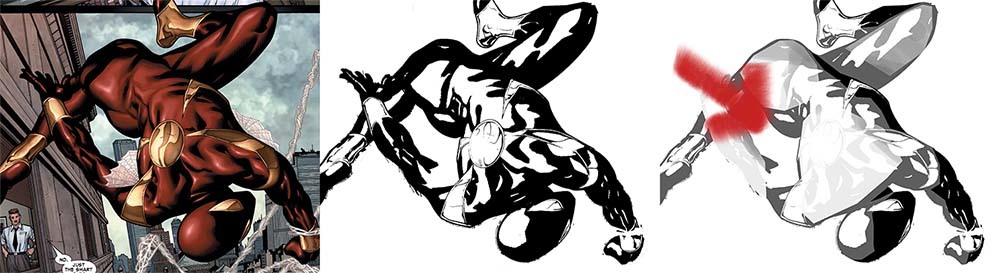
Here's an example!  It's Spiderman:

three versions of one spiderman comic showing how the lineart could be edited in a way more conscious of lighting

Spiderman is swinging off, outside in the sunlight.  Look at all those muscles, picked out in red and gold.  Shiny shiny shiny.  Every muscle is shaded individually.  In the black and white version, every single muscle has its own large white highlight and its own dark black shadow.  If you squint at the middle Spiderman, he blends to an all-over average of grey.  The detail is taking priority over the body.

In the third picture, I've put a big red arrow showing where the light is coming from.  I used the highlight on Spiderman's head to estimate the angle.  Looking at the light, it's obvious that Spiderman's back and shoulders are getting hit most directly.  However, they're not the brightest part of Spiderman's body in the drawing.  It's the same as his butt and his legs, which are struck more indirectly by the sun.

Using photoshop and a mouse, I've roughed in the brightest areas and lightened them, reducing the contrast there.  Instead of each muscle being shaded from black to white, the shadows that are getting hit by the sun are light grey, closer to white.  In the indirect sunlight, the shadows are still black.  This means that Spiderman's body as a whole is shaded from black to white.  If you squint at the third picture, instead of a grey silhouette you get something with light spots and dark spots.  You can lose the detail without losing the fundamental form of Spiderman.

So, back to the title of this post.  We can imagine any solid as a collection of planes, flat surfaces joined together to make a sort of very complicated polygon, like a 3D character in a computer program.  Good drawings, ones that have a convincing sense of mass, focus first on the largest planes.  For example, the large span of Spiderman's back.  That should take priority over the smaller, more complex planes of this trapezius muscles.  After all, the point of the drawing isn't that Peter Parker has sick traps.  The point is that Spiderman is zipping off to do Spiderman stuff. 

Too often, comics art fails the consider the simple, important planes that define the body before they consider the details.  They fail to sit back, look for the fundamental, simple shapes, and consider how the light will touch them.

One final note: the picture of Spiderman I chose is one I was initially picked for its crazy anatomy.  Look at how insanely long they've made Spidey's thigh so they can show you his entire ass.  Amazing.  However, after looking at it longer, I think the bad anatomy is a secondary issue.  Comic characters get slammed a lot for not having bones, but I think that problem springs from the artist trying to draw a 2D picture that looks good because it's detailed instead of a 2D picture that looks good because it effectively conveys weight and movement.

That concludes today's gripes!  That got longer than I expected.  Now I'm going to go read more comics.


October 2019

S M T W T F S
  12345
6789 101112
13141516171819
20212223242526
2728293031  

Syndicate

RSS Atom

Most Popular Tags

Style Credit

Expand Cut Tags

No cut tags
Page generated Dec. 24th, 2025 04:05 am
Powered by Dreamwidth Studios