![[personal profile]](https://www.dreamwidth.org/img/silk/identity/user.png) isozyme
isozyme"Agnes Martin!" I shouted out loud when I saw the featured gallery last time I was in the contemporary section of the Philadelphia Museum of Art. "I love her so much, I love her, look, look at these, oh my god they have her letters!"
Agnes Martin's art looks like this:

She was obsessed with the appearance of perfection in things that are, by nature, not perfect. Her grid drawings aren't completely regular, even though they look it. I think her work is about how despite the fact that we all see the same reality, there's a difference between the vista in front of us and the way we construct it in our mind. "When I think of art, I think of beauty. Beauty is the mystery of life. It is in the mind, not in the eye. In our minds, we have an awareness of perfection that leads us on." In a letter, she writes: "Your work must hold some of this reality for you. If it does not it will not mean anything to anyone."
To me, her drawings are absolutely beautiful, meditative, and rigorous. They have soul. If I had several thousand dollars to spare, I would be sorely tempted to buy one and place it in my home.
How could the museum do a better job conveying this?
This gallery did a better job than usual -- there were many of her works next to each other, and her letters were displayed alongside them. The words of the artist are always important to me. They're the starting point
The letters were written the artist's brisk cursive: beautiful objects, but difficult to read. Anyone using a wheelchair couldn't get close enough to see the words. Posting transcripts in a large, clear font would be a good first step. She gave many recorded lectures; there's no reason not to play her voice and show her face in motion. I'd propose playing video in addition to the letters. The audio could be piped through headphones, as well as subtitled.
But to truly understand something, it's not good enough to have the ideas told to you in words; they're best when they come from one's own mind. A museum should pose a question and then present us with the objects we need to answer that question.
Early in her career Agnes Martin left New York for New Mexico. Her relationship with nature and land is obvious. She despised squares, and was suspicious of vertical lines in general. In her own words: "When I cover the square surface with rectangles, it lightens the weight of the square. Destroys its power." "And I thought there wasn’t a line that affected me like a horizontal line. [...] And I thought to myself, there aren’t too many verticals I like. But I did put a few in there." Place two photographs on the wall: one of the long, flat horizon of New Mexico, one of the towering buildings in Manhattan. Now do her paintings have more meaning?
She was insistent that although her drawings looked like flawless grids, they were filled with errors. It would be easy to print a crisp, computer-generated grid with the same number and arrangement of lines as an Agnes Martin piece and place them side by side; the same size, the same color, only one is actually perfect.
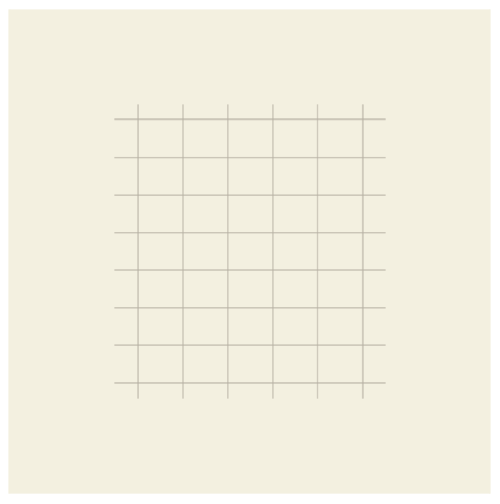 Here is a copy of the above drawing perfected by photoshop. Does this illuminate the soul and beauty of the work? It's okay if it doesn't. You may like or dislike both equally. But I believe the comparison is interesting no matter your reaction.
And last, I would provide pencils (without erasers), and pads of paper, and invite anyone who wished to draw their own grids. Do you take pride, too, in the ability to draw many straight lines? It's difficult! It's easy to make mistakes. The museum could help you to feel an echo of the body of the artist in your own body.
When I look at a room filled with only her drawings, hung on white walls with tiny placards, I think of all these things and more. That's the benefit of an art degree. That's why I bounced with glee walking into that room, and why I hurried to stand as close to the glass as was polite, and it's why I wouldn't leave until I had read all the letters, to the annoyance of my companions.
alas, there were a couple facts about agnes martin i couldn't fit in the essay, so here they are: 1) she burned her drawings and paintings ALL THE TIME, she'd get fed up and just be like "time for fire!" 2) she resisted selling her stuff until she was really starving. then afterwards she said she always regretted it because she hated thinking about her art being in the home of someone she didn't like (and i get the impression there were a lot of people she disliked)
Agnes Martin's art looks like this:
She was obsessed with the appearance of perfection in things that are, by nature, not perfect. Her grid drawings aren't completely regular, even though they look it. I think her work is about how despite the fact that we all see the same reality, there's a difference between the vista in front of us and the way we construct it in our mind. "When I think of art, I think of beauty. Beauty is the mystery of life. It is in the mind, not in the eye. In our minds, we have an awareness of perfection that leads us on." In a letter, she writes: "Your work must hold some of this reality for you. If it does not it will not mean anything to anyone."
To me, her drawings are absolutely beautiful, meditative, and rigorous. They have soul. If I had several thousand dollars to spare, I would be sorely tempted to buy one and place it in my home.
How could the museum do a better job conveying this?
This gallery did a better job than usual -- there were many of her works next to each other, and her letters were displayed alongside them. The words of the artist are always important to me. They're the starting point
The letters were written the artist's brisk cursive: beautiful objects, but difficult to read. Anyone using a wheelchair couldn't get close enough to see the words. Posting transcripts in a large, clear font would be a good first step. She gave many recorded lectures; there's no reason not to play her voice and show her face in motion. I'd propose playing video in addition to the letters. The audio could be piped through headphones, as well as subtitled.
But to truly understand something, it's not good enough to have the ideas told to you in words; they're best when they come from one's own mind. A museum should pose a question and then present us with the objects we need to answer that question.
Early in her career Agnes Martin left New York for New Mexico. Her relationship with nature and land is obvious. She despised squares, and was suspicious of vertical lines in general. In her own words: "When I cover the square surface with rectangles, it lightens the weight of the square. Destroys its power." "And I thought there wasn’t a line that affected me like a horizontal line. [...] And I thought to myself, there aren’t too many verticals I like. But I did put a few in there." Place two photographs on the wall: one of the long, flat horizon of New Mexico, one of the towering buildings in Manhattan. Now do her paintings have more meaning?
She was insistent that although her drawings looked like flawless grids, they were filled with errors. It would be easy to print a crisp, computer-generated grid with the same number and arrangement of lines as an Agnes Martin piece and place them side by side; the same size, the same color, only one is actually perfect.
And last, I would provide pencils (without erasers), and pads of paper, and invite anyone who wished to draw their own grids. Do you take pride, too, in the ability to draw many straight lines? It's difficult! It's easy to make mistakes. The museum could help you to feel an echo of the body of the artist in your own body.
When I look at a room filled with only her drawings, hung on white walls with tiny placards, I think of all these things and more. That's the benefit of an art degree. That's why I bounced with glee walking into that room, and why I hurried to stand as close to the glass as was polite, and it's why I wouldn't leave until I had read all the letters, to the annoyance of my companions.
alas, there were a couple facts about agnes martin i couldn't fit in the essay, so here they are: 1) she burned her drawings and paintings ALL THE TIME, she'd get fed up and just be like "time for fire!" 2) she resisted selling her stuff until she was really starving. then afterwards she said she always regretted it because she hated thinking about her art being in the home of someone she didn't like (and i get the impression there were a lot of people she disliked)


no subject
Date: 2019-04-09 03:50 am (UTC)(And if you need to do side-by-side blind testing to distinguish two bits of art, that says something else altogether)
no subject
Date: 2019-04-20 02:37 pm (UTC)sometimes you're hannibal buress saying "all colorfields is the same" and, honestly, you could write a damn good art history thesis arguing that. It's absurd, it's elitist, and it fetishizes the work of the individual to an obscene level (millions of dollars! you know what i could do with millions of dollars? i could find the time to reproduce a rothko, that's for sure).
i'll admit that there are agnes martin works that are less close to perfect grids -- i suspect she drew the one in the example with the help of a ruler, although i'm not sure. but i was lazy and that one was simple so i went with it.
man, it would be so fun to reproduce Famous Works Of Minimalist Art in something like MS Paint, print them out really big, and hang them in all seriousness. i wonder if anyone's done it, it would be SUCH a great "fuck you" to the art industry, and also revitalize concepts like how frank stella painted with radiator paint instead of oils because he wanted to show that "art materials" weren't holy, esoteric objects and weren't better than the things we use every day; everyone has MS Paint (or did, it's a bit retro now). How to print it would be tricky, I hate decisions about what paper to use...maybe using projectors, actually would be better, projectors and screens can get the scale you'd want and have more fidelity to the new medium...
this is what my art brain is like, i apologize. everything is interesting! no emotional reaction to art is wrong, but every emotional reaction to art can be interrogated in valuable ways!